Feb. 05, 2026
As the use of agricultural amino acids continues to grow, many fertilizer manufacturers and agricultural buyers encounter different grades such as Agricultural Amino Acid 80, 85, and 90.
These numbers refer to total amino acid content, and each grade is designed for different formulation needs, cost structures, and target markets.
This article explains the key differences between agricultural amino acid 80 / 85 / 90, their typical uses, and how to choose the right grade for agricultural applications.
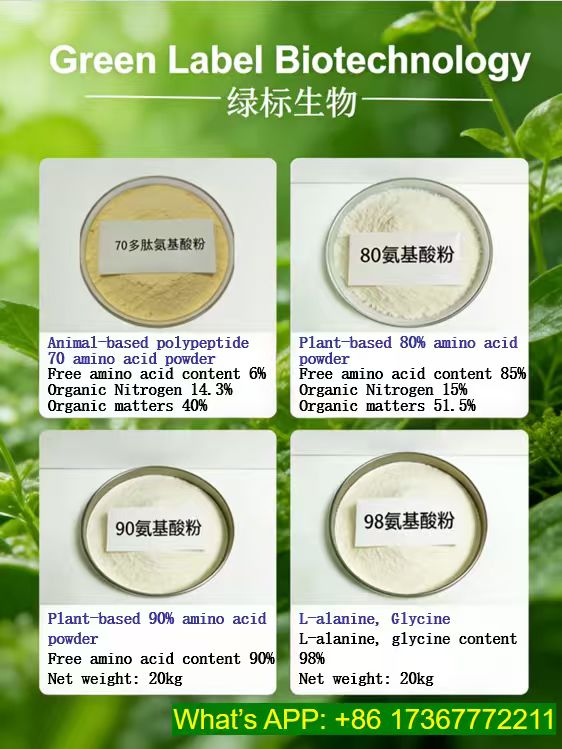
The numbers 80, 85, and 90 indicate the percentage of total amino acids in the product.
Agricultural Amino Acid 80 → ≥80% total amino acids
Agricultural Amino Acid 85 → ≥85% total amino acids
Agricultural Amino Acid 90 → ≥90% total amino acids
Higher content means:
More active amino acids per unit
Higher formulation efficiency
Lower dosage required
However, higher content is not always necessary for every application.
Agricultural Amino Acid 80 is the most widely used grade in agriculture.
Typical uses:
Standard amino acid fertilizer production
Foliar and soil fertilizer formulations
Large-volume agricultural programs
Why buyers choose it:
Cost-effective
Stable performance
Easy formulation
Suitable for mass-market fertilizers
Best choice for buyers prioritizing volume and cost control.
Agricultural Amino Acid 85 offers a balance between cost and performance.
Typical uses:
Mid- to high-end fertilizer formulations
Export-oriented fertilizer products
Improved nutrient efficiency programs
Why buyers choose it:
Higher active content than 80
Lower inclusion rate
Better product positioning
Ideal for buyers upgrading product quality without moving to premium pricing.
Agricultural Amino Acid 90 is designed for advanced and premium agricultural applications.
Typical uses:
High-end fertilizer products
Specialty and high-value crops
Precision and sustainable agriculture
Why buyers choose it:
Maximum amino acid concentration
Strong differentiation in premium markets
Highest formulation efficiency
Best suited for buyers targeting performance-focused or premium markets.
| Factor | Amino Acid 80 | Amino Acid 85 | Amino Acid 90 |
|---|---|---|---|
| Total Amino Acid Content | ≥80% | ≥85% | ≥90% |
| Cost Level | Lowest | Medium | Highest |
| Dosage Efficiency | Standard | Higher | Highest |
| Typical Market | Mass | Mid–High | Premium |
| Formulation Flexibility | High | High | Medium–High |
Many fertilizer manufacturers use multiple grades depending on product lines:
80 → standard fertilizers
85 → enhanced or export products
90 → premium or specialty fertilizers
This approach allows manufacturers to serve different market segments efficiently.
Before selecting an agricultural amino acid grade, buyers should consider:
Target crop and crop value
Fertilizer positioning (standard vs premium)
Cost structure and pricing strategy
Application method (foliar, soil, fertigation)
Market and regulatory expectations
Choosing the right grade helps optimize performance, cost, and competitiveness.
As agriculture focuses on efficiency and sustainability, higher-content amino acids allow:
Reduced application rates
Improved nutrient efficiency
Better formulation control
This explains the growing demand for 85% and 90% agricultural amino acid products in international markets.
Not necessarily. The best choice depends on formulation needs and market positioning.
Yes. Some manufacturers blend grades to balance cost and performance.
Yes. All grades are widely used in agricultural fertilizer applications.
Agricultural amino acids are available in different grades and forms to meet various agricultural and fertilizer production needs.
Learn more about amino acid powder grades (80 / 85 / 90), detailed specifications, and bulk supply options for fertilizer manufacturing.
Tags: biostimulant calcium rice based functional ingredients amino liquid 30% what is liquid aminos compound amino acid powder natural organic solution amino acids how to take what is amino liquid amino acid powder liquid amino acids for plants is liquid aminos good for you soy amino acids amino acid chelated calcium amino liquid supplement soy amino acid profile liquid aminos benefits
water soluble amino acids liquid fertilizers custom manufacturing
NPK 20-20-20 Liquid Fertilizer: Balanced Nutrition for All Crops
Feb. 24, 2026
NPK Solution: Complete Guide for Agriculture, Fertigation & Hydroponics
Feb. 24, 2026
NPK Fertilizer for Vegetables: Complete Guide to Higher Yields & Better Quality
Feb. 24, 2026
Hello, welcome to submit any questions and suggestions. We will reply to you as soon as possible. Thank you for your support and help.

Our team of experienced experts can’t wait to help you find the right solution for your business, Write to us and we'll get back to you!
CONTACT US TODAY